In 2013, 56 million tons of PET were manufactured – about a quarter of all plastics produced that year – but only 2.2 million tons were recycled, the team says.
Nature has beaten us to it again. It has taken just 70 years for evolution to throw up a bacterium capable of breaking down and consuming PET, one of the world’s most problematic plastic pollutants.
Japanese researchers discovered and named the species, Ideonella sakaiensis, by analysing microbes living on debris of PET (polyethylene terephthalate) plastics they collected from soil and wastewater.
The bacterium seems to feed exclusively on PET and breaks it down using just two enzymes.
It must have evolved in just 70 years the capability to do this because the plastics were only invented in the 1940s.
The team hopes the discovery will lead to new ways of breaking down plastic, using either the bacteria themselves, or the two enzymes they use for the job.
So how do the bacteria do it?
They link to the PET with tendril-like threads. They then use two enzymes sequentially to break down PET into terephthalic acid and ethylene glycol, the two substances from which it is manufactured and that are not harmful to the environment.
The bacteria then digest both substances. This could mean they would be useful for getting rid of polluting plastics in the environment.
Their ability to reconstitute the starting materials also lends them to recycling strategies. But the process takes a long time – about 6 weeks at 30°C to fully degrade a thumb-nail-sized piece of PET.
“We have to improve the bacterium to make it more powerful, and genetic engineering might be applicable here,” says Oda, whose team is already experimenting with this.
One way of speeding things up would be to transfer the genes that make the two enzymes into a faster growing bacterium like Escherichia coli, says Uwe Bornscheuer of Greifswald University in Germany.
MaryJane, is there anything you can’t make better?
“The cannabis fiber appears to have a better quality and durability than other fibers. Moreover, the cannabis’ gum and sticky properties might have helped clay and lime to form a firm binder,” Sardesai told Times of India.
Today called hempcrete, the concrete-like substance used for plastering provided “a healthy, comfortable and aesthetically pleasing living environment to the Buddhist monks to stay,” the researchers said.
“As the hemp plaster has the ability to store heat, is fire-resistant and absorbs about 90 percent of airborne sound, a peaceful living environment for the monks has been created at Ellora Caves,” they added.
Studies in Europe have estimated that hempcrete can last 600–800 years. In the Ellora caves the life span doubled despite damaging environmental factors, such as a growing humidity inside the caves during rainy seasons.
The Ellora caves were built between the 6th and 11th centuries, A.D. in the western state of Maharashtra. They are made up of a group of 34 temples carved out of stone and are dedicated to the three main religions of India — Buddhism, Hinduism and Jainism.
The structure runs in a north–south direction for about 1.2 miles. At the southern end are 12 Buddhist caves, in the north are six Jain caves and in between lie 17 Brahmanical caves.
“The caves are breathtaking examples of rock-cut architecture that stands testimony to the imagination and artistry of its creators,” Singh and Sardesai wrote in the journal Current Science.
But I got buttons for all the cool bands.
Cleaning my house I came across all my 70s & 80s buttons. These are just the ones from bands I saw, more decorative ones to follow.
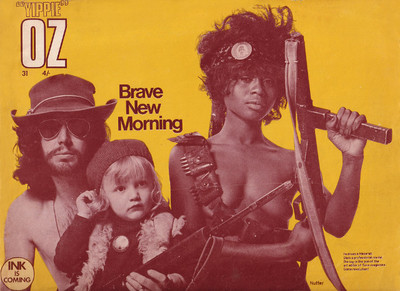
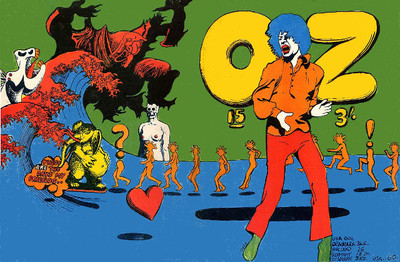
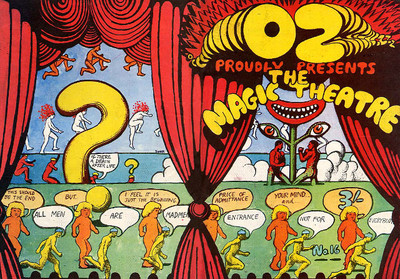
In The Guardian, Chitra Ramaswamy describes the London magazine as “the icon – and the enfant terrible – of the underground press. Produced in a basement flat off Notting Hill Gate, Oz was soon renowned for psychedelic covers by pop artist Martin Sharp, cartoons by Robert Crumb, radical feminist manifestos by Germaine Greer, and anything else that would send the establishment apoplectic.
By August 1971, it had been the subject of the longest obscenity trial in British history. It doesn’t get more 60s than that.” Even its print run, which began in 1967 and ended in 1973, perfectly brackets the period people really talk about when they talk about the sixties.
OZ magazine, London, 1967-1973
Unfortunately, I can’t figure out how to link each of the above covers to the individual issues, so you’ll have to go to Australia to read each issue.
U.S. citizens used to have the option to add new visa pages to their passport, but as of January 1 new passports can contain only 28 or 52 pages. The restriction, which the Department of State says “was made to enhance the security of the passport and to abide by international passport standards,” is thought to be motivated by concerns about visa fraud.But for Eric Oborski, the man who may own the world’s largest passport, January 1 wasn’t a day of mourning. His passport—which for now contains “only” 192 pages, nearly 100 more than the other contender for world’s largest—has now passed into the realm of hallowed relic.
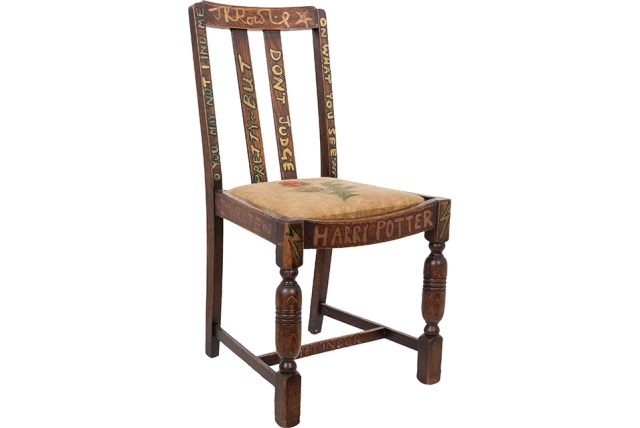
NEW YORK, NY.- The chair used by author J.K. Rowling while she wrote the first two Harry Potter books — Harry Potter and the Philosopher’s Stone and Harry Potter and the Chamber of Secrets — will cross the auction block in New York on April 6, 2016.
Indeed, the aforementioned owner, who used the piece of furniture in her Edinburgh council flat, is the reason the item is expected to fetch more than $45,000 (£32,000) at auction.
“The international phenomenon that would become, and still is, Harry Potter had its humble beginnings in this modest old chair,” said James Gannon, Director of Rare Books at Heritage Auctions, the company conducting the auction. “It’s inspiring to imagine the young mother and author settling down at her desk, seated in this chair, typing out the original manuscripts of her first two books.”
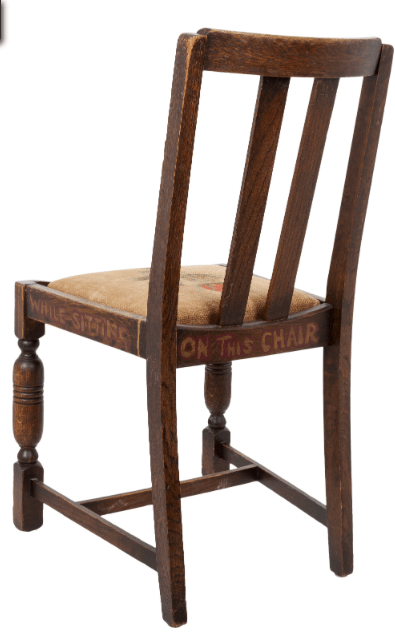
Rowling signed the backrest in the gold and rose paints. Then along the apron of the seat she painted: “I wrote / Harry Potter / while sitting / on this chair.”
The chair comes from a set that Rowling was given for her government housing flat when she was a young, single mother living in Edinburgh, Scotland. Rowling took the most comfortable of the chairs and used it as her main writing chair, authoring the first two of what would become one of the most influential series of all time: Harry Potter and the Philosopher’s Stone (released in America as Harry Potter and the Sorcerer’s Stone) and Harry Potter and the Chamber of Secrets.
A few years after the publication of Harry Potter and the Goblet of Fire, Rowling donated the chair to a small auction in 2002 called Chair-ish a Child, in aid of the National Society for the Prevention of Cruelty to Children (NSPCC) where it went for £15,000. Rather than selling it in its original form, Rowling used gold, rose, and green paints to transform the chair into a piece of literary memorabilia.
On the stiles and splats, in gold and rose colors, she painted: “You may not / find me pretty / but don’t judge / on what you see.”
“Gryffindor” is painted on the cross stretcher under the seat.
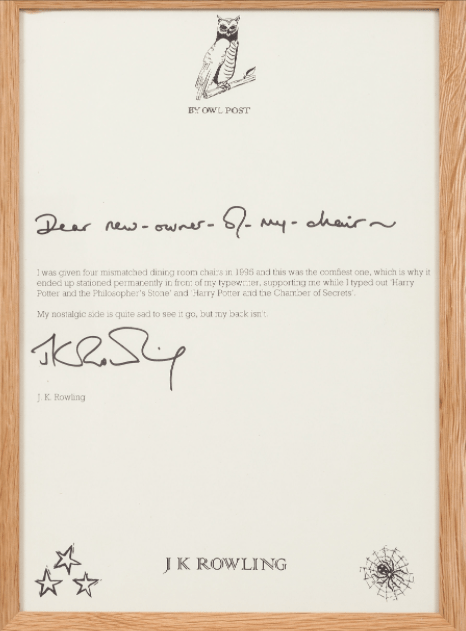
Accompanying the chair is the original “Owl Post” that Rowling typed and signed to the winner of the Chair-ish a Child auction.
It reads: “Dear new-owner-of-my-chair~
I was given four mismatched dining room chairs in 1995 and this was the comfiest one, which is why it ended up stationed permanently in front of my typewriter, supporting me while I typed out ‘Harry Potter and the Philosopher’s Stone’ and ‘Harry / Potter and the Chamber of Secrets’.
My nostalgic side is quite sad to see it go, but my back isn’t.
J. K. Rowling.”
James Gannon, director of rare books at Heritage Auctions, said he would be surprised if the chair didn’t sell for at least $75,000.
“I think it easily could best $100,000 too,” he told the Guardian. “For me, what’s important about the chair is that [Rowling] basically created a unique artwork that’s self-reflexive. It’s all about her creation.
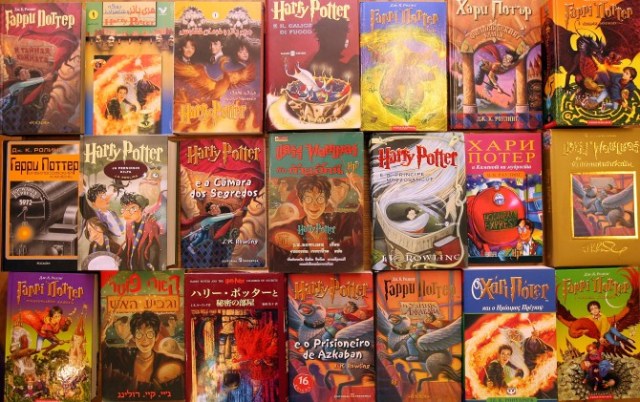
“There’s not that much in Harry Potter world that’s very valuable or very rare because the books were so big so quickly, so after the first couple of books, the first editions were quite large, and I think, by the end, they were printing like 8 million or 10 million copies of the first edition.”
The book was handwritten and illustrated by the author herself. She gave six copies to people who helped Harry Potter become phenomenal and auctioned the final copy with the help of Amazon for the benefit of Rowling’s own charity, Lumos.
Meanwhile, Harry Potter fans can also make the most out of the old versions of their books. AbeBooks recently sold a 1996 edition of the Harry Potter and the Philosopher’s Stone for a staggering $37,151.98. As per the company, only 500 copies of the early hardback edition went out for sale, making them rare.
Last month, Iwo Jima veteran Leo Bradley went to his local Wisconsin polling place to cast his vote in a statewide election. He took the trip with wife and his veterans affairs card in hand, but was told that the card was not an “acceptable proof of his identity.”
He was told, “Only an active duty military card would be good enough.”
Here’s the truth: as a number states change their laws to make it harder for everyone to vote, veterans, especially retired veterans who no long carry active drivers licenses, are often left out in the cold.
Leo Bradley’s niece, Justice Anne Walsh Bradley, happens to sit on the state’s Supreme Court, which is how this issue got our attention. But how many veterans — Republicans, Democrats, and Independents alike — without powerful relatives have had their right to vote taken away from them, and how many more will be turned away at the polls this November?
Justice Bradley wrote in her letter to Governor Walker, “My Uncle Leo served during Iwo Jima, which has been described as one of the bloodiest battles of World War II. … Now my Uncle Leo fights another battle — the battle to be able to vote in his hometown of almost 60 years.”
I’m happy to join Uncle Leo in his fight against discriminatory voter ID laws. And if you add your name, VoteVets will make sure Scott Walker knows where veterans, military family members, and VoteVets supporters stand on this issue.
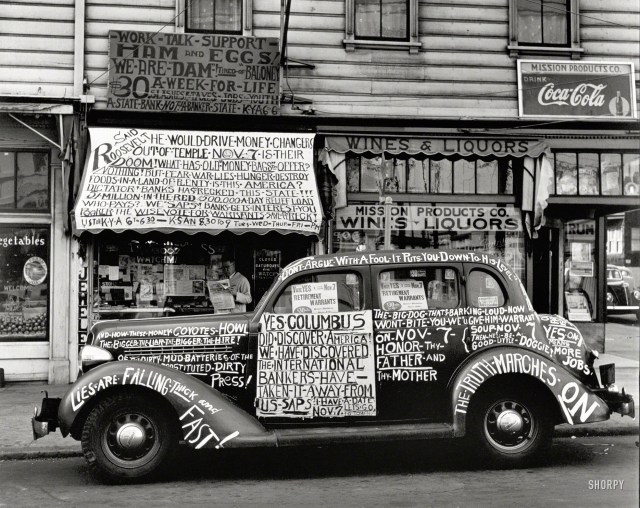
Most of the text in this photo relates to Proposition 25, an initiative on the November 1938 ballot in California to create a system of “retirement warrants” in place of public assistance for anyone qualified to vote in California and aged fifty or older without a job would receive $30 of “warrants” every week. Each $1 warrant would require a two-cent tax paid weekly to keep the note valid until redeemed. The warrants would be legal tender for payment of state taxes.
Had it been adopted and implemented, retired California residents in that age range would have received tax-and-interest-free self-liquidating “warrants” of $30 a week for life.
It was assumed that to avoid paying the weekly taxes on the money, the tender would be spent immediately, thus boosting the depressed economy. A cited example was the opportunity to trade up in foodstuffs from breakfast oatmeal to ham and eggs, hence the name ‘Ham and Eggs Movement’. While it may not have had an effect on the economy, similar plans gave Social Security a more moderate face.
It failed to pass, by a relatively small margin of 1,143,670 to 1,398,999.






























 The Truthiness Shall Set You Freak
 Stannous Flouride's Book of Truthiness