
David Mitchell posits a possible form of post-life existence that atheists would find highly disappointing:
I’m still chuckling.
David Mitchell posits a possible form of post-life existence that atheists would find highly disappointing:
I’m still chuckling.
CINCINNATI (The Borowitz Report)—Republican front-runner Donald Trump was crying foul on Monday after Vermont Senator Bernie Sanders allegedly dispatched an army of vegan thugs to attack a rally of peace-loving Nazis in Cincinnati.
According to Trump, he had begun to address a group of “orderly and civil Nazis” at a downtown arena when his audience was suddenly set upon by an unruly mob of angry vegans, many menacingly clad in Birkenstocks and sustainable garments.
“Make no mistake about who is starting the violence at these rallies,” Trump said. “It’s the vegans.”
Carol Foyler, a Nazi from suburban Cincinnati, said that she feared for her life when one of the vegans “ripped a Trump sign” from her hands and “tried to recycle it.”
Source: Sanders Sends Vegan Thugs to Attack Peace-Loving Nazis – The New Yorker
A new type of graphene-based filter could be the key to managing the global water crisis, a study has revealed. The new graphene filter, which has been developed by Monash University and the University of Kentucky, allows water and other liquids to be filtered nine times faster than the current leading commercial filter.
According to the World Economic Forum’s Global Risks Report, lack of access to safe, clean water is the biggest risk to society over the coming decade. Yet some of these risks could be mitigated by the development of this filter, which is so strong and stable that it can be used for extended periods in the harshest corrosive environments, and with less maintenance than other filters on the market.
The research team was led by Associate Professor Mainak Majumder from Monash University. Associate Professor Majumder said the key to making their filter was developing a viscous form of graphene oxide that could be spread very thinly with a blade.
“This technique creates a uniform arrangement in the graphene, and that evenness gives our filter special properties,” Associate Prof Majumder said.
This technique allows the filters to be produced much faster and in larger sizes, which is critical for developing commercial applications. The graphene-based filter could be used to filter chemicals, viruses, or bacteria from a range of liquids. It could be used to purify water, dairy products or wine, or in the production of pharmaceuticals.
This is the first time that a graphene filter has been able to be produced on an industrial scale – a problem that has plagued the scientific community for years.
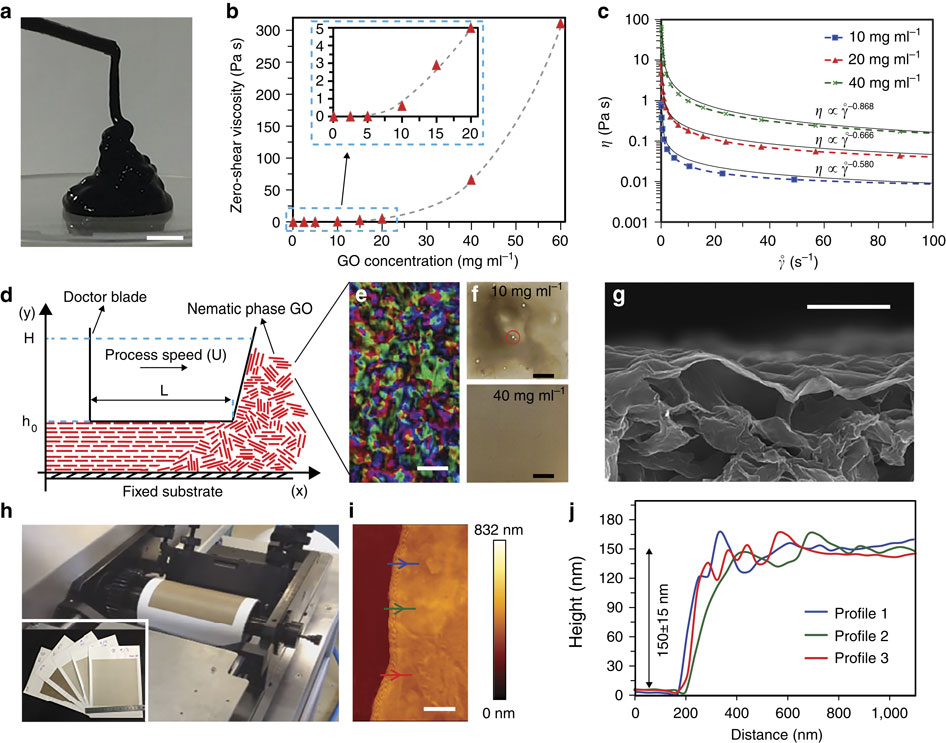
(a) Viscoelastic property of GO (~40 mg ml−1). Scale bar, 1 cm. (b) Zero-shear viscosity of the dispersions increases with increasing GO concentration. Dashed line is a polynomial fit. (c) Rheology data for three different concentration showing shear-thinning behavior. Solid curves are the fit of the experimental data with a power law model. (d) Schematic of shear-alignment processing of a nematic GO to a film; L is the width of blade, h0 is the height of the channel, H is the height of the fluid in front of the blade and U is the processing speed. (e) Polarized light images of fully nematic GO at 40 mg ml−1 (scale bar, 1 μm). (f) The red circle in the photograph identfies dewetting spots in the SAMs, which is eliminated when processed from liquid crystalline GO (scale bars, 1 cm). (g) An SEM image demonstrates continuity and conformity of SAM over a porous Nylon substrate (scale bar, 1 μm). (h) Photograph of the gravure printing machine and (inset) images of 13 × 14 cm2 GO membranes with different thicknesses. (i,j) AFM height map and corresponding height profiles of our membrane (scale bar, 1 μm).
“It’s been a race to see who could develop this technology first, because until now graphene-based filters could only be used on a small scale in the lab,” Mr Akbari said.
Graphene is a lattice of carbon atoms so thin it’s considered to be two-dimensional. It has been hailed as a “wonder-material” because of its incredible performance characteristics and range of potential applications.
The team’s new filter can filter out anything bigger than one nanometre, which is about 100,000 times smaller than the width of a human hair.
The research has gathered interest from a number of companies in the United States and the Asia Pacific, the largest and fastest-growing markets for nano-filtration technologies.
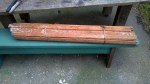
Pulled this bundle of unused redwood lath (as used in lath and plaster walls) out of the debris from the renovations next door.


Also occurring on Pi Day (a strictly American celebration since we do our dates backwards from the rest of the world),

Eli Whitney patents the cotton gin (1794), Charles Darwin set sail aboard the Beagle (1836), California legislature approves Golden Gate Park measure (1870), San Francisco’s Sutro Baths open (1896), RIAA certifies 1st gold record, Perry Como’s Catch A Falling Star (1958), Linux version 1.0.0 is released (1996), The first World Maths Day was celebrated (2007).
The young of our strange species are pretty entertaining:


Chinese dissident artist Ai Weiwei set up a white grand piano in the muddy, rain-drenched refugee Idomeni camp on the Greek-Macedonian border Saturday, allowing 24 year-old Nour Alkhzam, a refugee from the city Deirez Zor, Syria, to play it.
The young woman is currently trying to get to Germany where her husband has been living for 18 months.
Ai Weiwei told journalists that she had been studying piano but had to stop because of the war in Syria.
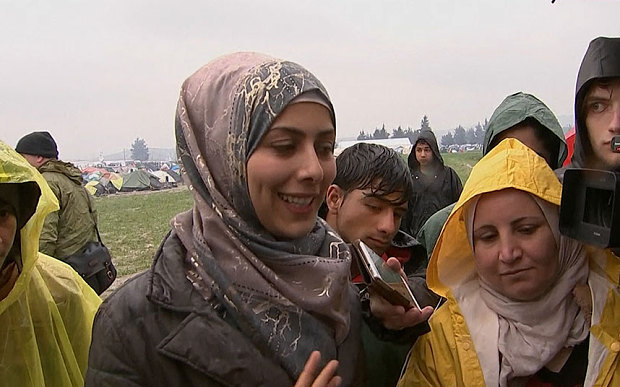
“This is our attempt to create an opportunity for this lady,” Ai said at the end of the impromptu performance.
“She has been victimized by these wars. She has not had the chance to touch a piano in three years. She and her husband have been separated for one-and-a-half years.”
Watching her play was “very touching. It tells the world that art will overcome the war. We want to reveal a new image of them, to relay possibility, art and imagination. This is the image that needs to be relayed to the world,” he told reporters.
Greek authorities estimate that 12,000 people are stuck at the camp at Idomeni, but thousands more are camped out in fields nearby, waiting in vain for the border to reopen so they can continue their journey north.
Macedonia and several other countries on the migrant trail have sealed their borders over recent weeks, leaving the Greek government to struggle with a huge bottleneck of people stuck on its territory and forced to camp in increasing squalor.
Ai, a thorn in the side of China’s Communist authorities, has repeatedly spoken out in support of refugees and denounced European politicians’ handling of the crisis.
Last month, he draped thousands of lifejackets discarded by migrants arriving in Greece around the columns of Berlin’s Konzerthaus concert hall.
And in January, the artist closed down an exhibition of his work in Copenhagen in protest after lawmakers passed a controversial bill allowing authorities to seize valuables from asylum seekers.
Source: Chinese dissident artist Ai Weiwei brings white grand piano to muddy refugee field
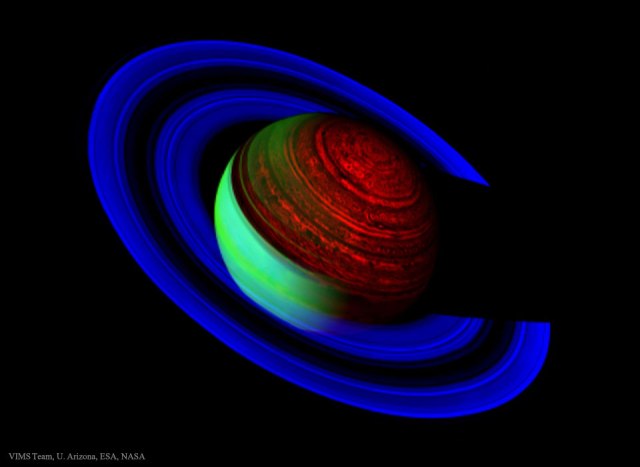 Explanation: If seen in the right light, Saturn glows like a neon sign. (Although Saturn has comparatively little of the element neon, a composite image false-colored in three bands of infrared light highlights features of the giant ringed planet like a glowing sign)
At the most blue band of the infrared light featured, false-colored blue in the above image, Saturn itself appears dark but Saturn’s thin rings brightly reflect light from our Sun.
Conversely, Saturn’s B ring is so thick that little reflected light makes it through, creating a dark band between Saturn’s A and C rings.
At the most red band of the infrared, false-colored red above, Saturn emits a surprisingly detailed thermal glow, indicating planet-wide bands, huge hurricane-like storms, and a strange hexagon-shaped cloud system around the North Pole.
In the middle infrared band, false-colored green, the sunlit side of Saturn’s atmosphere reflects brightly. The above image was obtained in 2007 by the robotic Cassini spacecraft orbiting about 1.6 million kilometers out from Saturn.
Image Credit: VIMS Team, U. Arizona, ESA, NASA
In their study, researchers assigned 368 people 60-years-old and older who had received medical attention for a fall into one of two groups. The first group received hour-long individual tai chi classes conducted by tai chi instructors every week for 24 weeks.

Tai chi is an exercise practice developed in China hundreds of years ago. It combines certain postures and gentle movements with mental focus, breathing, and relaxation. Tai chi can be practiced while you’re walking, standing, or even seated.
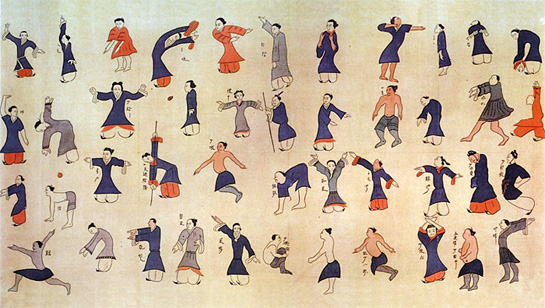
Deep breathing, weight shifting, and leg stepping movements are part of the practice. The second group received individual, hour-long lower extremity training (LET) sessions for 24 weeks conducted by physical therapists. Sessions included stretching, muscle strengthening, and balance training.

(Pretty sure these are Chinese garden gnomes, not study participants)
The researchers asked participants in both groups to complete at least 80 percent of their sessions, and also to practice either tai chi or LET at home every day during the six- month program and the 12-month follow-up. During the course of the study, all participants kept diaries and recorded any falls they experienced, and they shared their diaries with researchers each month.
After six months of training, people in the tai chi group were significantly less likely to experience an injury-causing fall than were people in the LET group. Even a year after taking the training, people who took tai chi were about 50 percent less likely to experience an injury-causing fall compared to people in the LET group.
Source: Practicing tai chi reduces risk of falling in older adults -Health in Aging.org
 The Truthiness Shall Set You Freak


 Stannous Flouride's Book of Truthiness