Breast cancer vaccine shows promise in small clinical trial

The new vaccine causes the body’s immune system to home in on a protein called mammaglobin-A, found almost exclusively in breast tissue. The protein’s role in healthy tissue is unclear, but breast tumors express it at abnormally high levels, past research has shown.

“Being able to target mammaglobin is exciting because it is expressed broadly in up to 80 percent of breast cancers, but not at meaningful levels in other tissues,” said breast cancer surgeon and senior author William E. Gillanders, MD, professor of surgery. “In theory, this means we could treat a large number of breast cancer patients with potentially fewer side effects.

The vaccine primes a type of white blood cell, part of the body’s adaptive immune system, to seek out and destroy cells with the mammaglobin-A protein.
Although the trial was designed to test vaccine safety, preliminary evidence indicated the vaccine slowed the cancer’s progression, even in patients who tend to have less potent immune systems because of their advanced disease and exposure to chemotherapy.
Of the 14 patients who received the vaccine, about half showed no progression of their cancer one year after receiving the vaccine. In a similar control group of 12 patients who were not vaccinated, about one-fifth showed no cancer progression at the one-year follow-up. Despite the small sample size, this difference is statistically significant.

http://www.sciencedaily.com/releases/2014/12/141201090313.htm
Posted in Uncategorized | Leave a comment

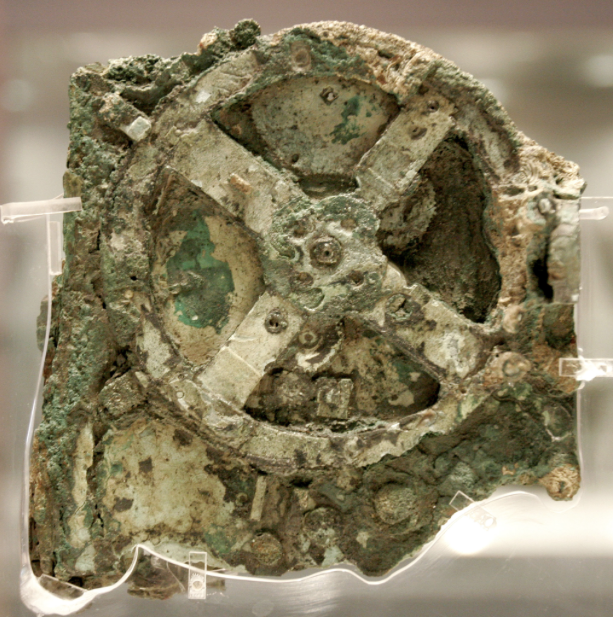
Solving the Riddles of the Antikythera Mechanism

The complex clocklike assembly of bronze gears and display dials accurately predicted lunar and solar eclipses, as well as solar, lunar and planetary positions. For good measure, the mechanism also tracked the dates of the Olympic Games.

Screen Shot 2014-12-03 at 1.00.10 AM

A new analysis of the dial used to predict eclipses, which is set on the back of the mechanism, provides yet another clue to one of history’s most intriguing puzzles.

Writing this month in the journal Archive for History of Exact Sciences, Dr. Carman and Dr. Evans took a different tack. Starting with the ways the device’s eclipse patterns fit Babylonian eclipse records, the two scientists used a process of elimination to reach a conclusion that the “epoch date,” or starting point, of the Antikythera Mechanism’s calendar was 50 years to a century earlier than had been generally believed.

The device itself bears inscriptions on the front and back. In the 1970s, the engravings were estimated to date from 87 B.C. But more recently, scientists examining the forms of the Greek letters in the inscriptions dated the mechanism to 150 to 100 B.C.

Screen Shot 2014-12-03 at 1.00.25 AM

An inscription on a small dial used to date the Olympic Games refers to an athletic competition that was held in Rhodes, according to research by Paul Iversen, a Greek scholar at Case Western Reserve University.

“If we were all taking bets about where it was made, I think I would bet what most people would bet, in Rhodes,” said Alexander Jones, a specialist in the history of ancient mathematical sciences at New York University.

Posted in Uncategorized | Leave a comment

Humans brought art with them wherever they settled

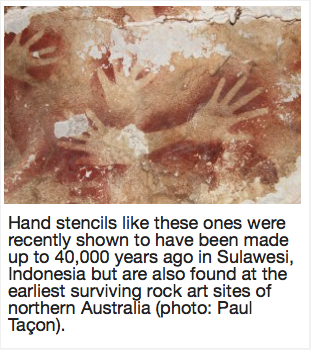
Latest research on the oldest surviving rock art of Southeast Asia shows that the region’s first people, hunter-gatherers who arrived over 50,000 years ago, brought with them a rich art practice.

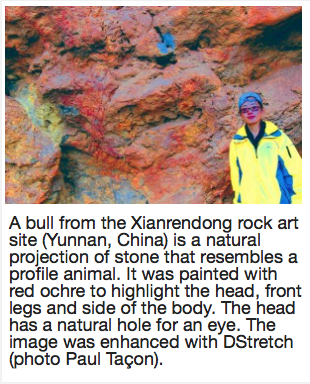
Published this week in the archaeological journal Antiquitythe research shows that these earliest people skilfully produced paintings of animals in rock shelters from southwest China to Indonesia. Besides these countries, early sites were also recorded in Thailand, Cambodia and Malaysia.

Screen Shot 2014-12-03 at 12.40.15 AM Screen Shot 2014-12-03 at 12.40.25 AM

Professor Taçon said that, “As with the early art of Europe, the oldest Southeast Asian images often incorporated or were placed in relation to natural features of rock surfaces.

“This shows a purposeful engagement with the new places early peoples arrived in for both symbolic and practical reasons.

“Essentially, they humanised landscapes wherever they went, transforming them from wild places to cultural landscapes. This was the beginning of a process that continues to this day.

Screen Shot 2014-12-03 at 12.40.37 AM

http://app.griffith.edu.au/news/2014/11/26/ancient-rock-art-discovery-across-asia/

Posted in Uncategorized | Leave a comment

My new orchid blooms

My second rescued orchid bloomed yesterday and today. It is an Oncidium, this variety called “Sherry Baby.” It has a faint chocolate smell.

Oncidium

Here’s one from online for clarity.

onc_sharry_baby

Posted in Uncategorized | Leave a comment

Largest Carved Stone Block From Antiquity Found

Found by a team from the German Archaeological Institute in a stone quarry at Baalbek in Lebanon.

The limestone quarry was located about a quarter of a mile from the temple complex known as Heliopolis and houses massive building blocks – one known as the “Hajjar al-Hibla,” (The Stone of the Pregnant Woman) weighs about 1000 tons (2 million lbs.).
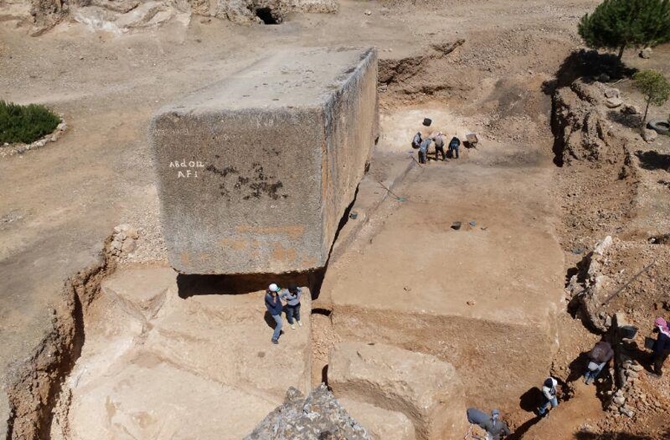
shown at left here:

dnews-files-2014-12-largest-stone-block-141201-jpg

Next to the fully exposed Hajjar al-Hibla stone and partially underneath it, the archaeologists found a third block still partially buried.
Shown above at right, the monolith measures 19.6 meters (64 feet) in length, 6 meters (19.6 feet) wide, and is at least 5.5 meters (18 feet) high. Its weight is estimated at 1,650 tons (that’s  about 33,000,000 lbs) making it biggest stone block from antiquity.

“The level of smoothness indicate the block was meant to be transported and used without being cut,” the German Archaeological Institute said in a statement. “Thus this is the biggest block known from antiquity,”

The team worked under the local supervision of Jeanine Abdul Massih:

138e151

Archaeologists believe the limestone blocks date back to at least 27 B.C., when Baalbek was a Roman colony and construction on three major and several minor temples began, lasting until the 2nd century A.D.

“Massive stone blocks of 19.6 meters (64 feet) long were used for the podium of the huge Temple of Jupiter in the sanctuary,” the archaeologists said.

Only portions of the temple remain, including six massive columns and 27 gigantic limestone blocks at its base. Three of them, weighting about 1,000 tons each, are known as the Trilithon:

trilithonTrilithon-1

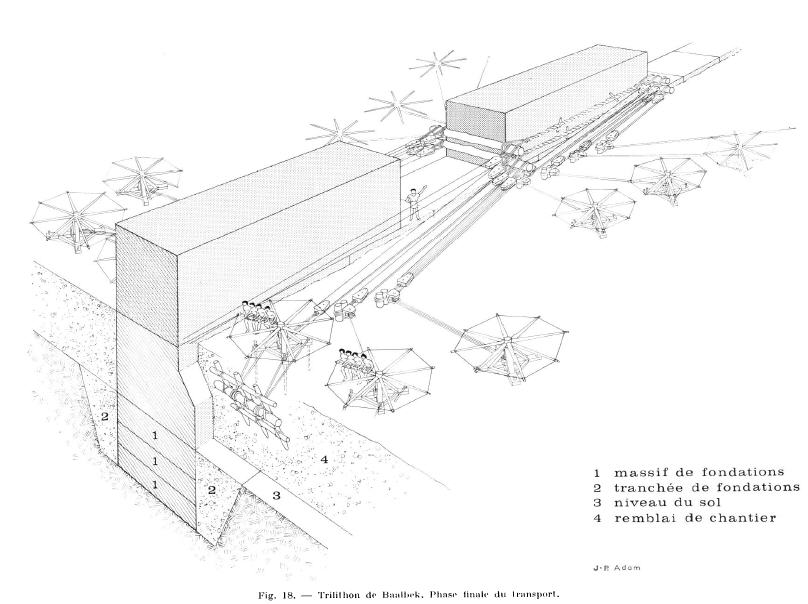
How these monoliths were transported and precisely positioned during the temple construction remains a mystery.

The newly uncovered stone block was likely cut to be used in the temple, but was probably abandoned because it was unsuitable for transporting.

Indeed, the Hajjar al-Hibla block nearby provided some clues: it was probably left in the quarry because the stone quality at one edge proved to be poor. “It would have probably cracked during transportation,” the archaeologists said.

Further excavations will attempt to establish whether the bigger block suffered from the same problem.

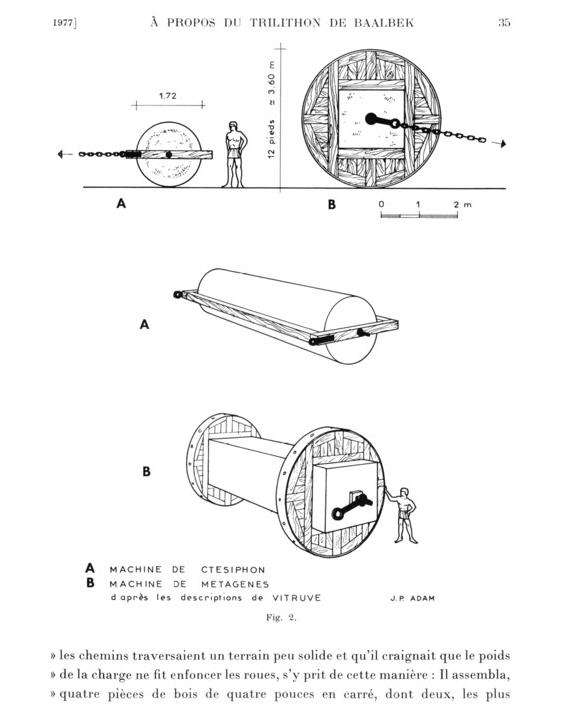
The above linked article by Dr Michael Heiser: ‘Transporting the Trilithon Stones of Baalbek: It’s About Applied Physics, Not Ancient Aliens’ is fascinating. Here are a couple of its diagrams from ancient and older sources:

trilithontransport megalithtransport

Posted in Uncategorized | Leave a comment

Booze culture may date back 10 million years, say scientists

It was hypothesised that the enzyme would not appear until the first alcohol was produced by early farmers. But scientists were amazed to find it 10 million years earlier, at the end of the Miocene epoch.

images

The findings could explain why tree-dwelling orangutans still cannot metabolize alcohol while humans, chimps and gorillas can.

http://www.telegraph.co.uk/news/science/science-news/11266265/Booze-culture-may-date-back-10-million-years-say-scientists.html

Posted in Uncategorized | Leave a comment

Creepy crawly cuddly critters

Posted in Uncategorized | Leave a comment

I just bought the right to keep this blog:

ad-free-banner2

This blog will remain ad free as long as I’m producing it.

Posted in Uncategorized | Leave a comment

Living Color

Posted in Uncategorized | Leave a comment

More Places to Go

Posted in Uncategorized | Leave a comment