
The complex clocklike assembly of bronze gears and display dials accurately predicted lunar and solar eclipses, as well as solar, lunar and planetary positions. For good measure, the mechanism also tracked the dates of the Olympic Games.
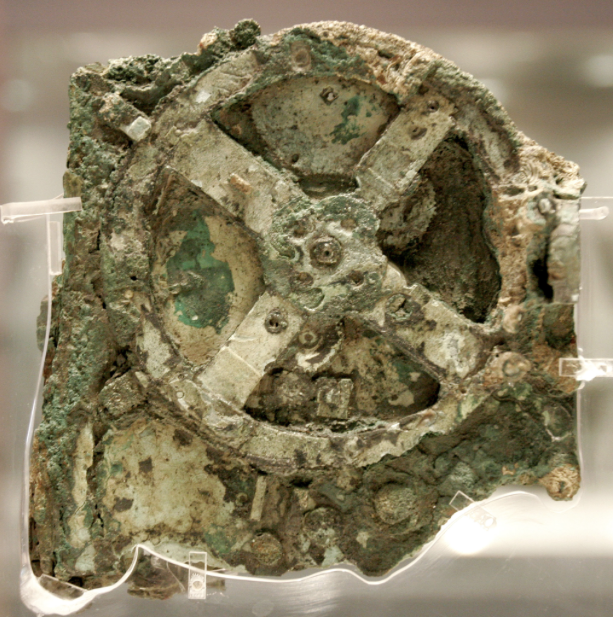
A new analysis of the dial used to predict eclipses, which is set on the back of the mechanism, provides yet another clue to one of history’s most intriguing puzzles.
Writing this month in the journal Archive for History of Exact Sciences, Dr. Carman and Dr. Evans took a different tack. Starting with the ways the device’s eclipse patterns fit Babylonian eclipse records, the two scientists used a process of elimination to reach a conclusion that the “epoch date,” or starting point, of the Antikythera Mechanism’s calendar was 50 years to a century earlier than had been generally believed.
The device itself bears inscriptions on the front and back. In the 1970s, the engravings were estimated to date from 87 B.C. But more recently, scientists examining the forms of the Greek letters in the inscriptions dated the mechanism to 150 to 100 B.C.

An inscription on a small dial used to date the Olympic Games refers to an athletic competition that was held in Rhodes, according to research by Paul Iversen, a Greek scholar at Case Western Reserve University.
“If we were all taking bets about where it was made, I think I would bet what most people would bet, in Rhodes,” said Alexander Jones, a specialist in the history of ancient mathematical sciences at New York University.


 Stannous Flouride's Book of Truthiness