
Found by a team from the German Archaeological Institute in a stone quarry at Baalbek in Lebanon.
The limestone quarry was located about a quarter of a mile from the temple complex known as Heliopolis and houses massive building blocks – one known as the “Hajjar al-Hibla,” (The Stone of the Pregnant Woman) weighs about 1000 tons (2 million lbs.).
shown at left here:
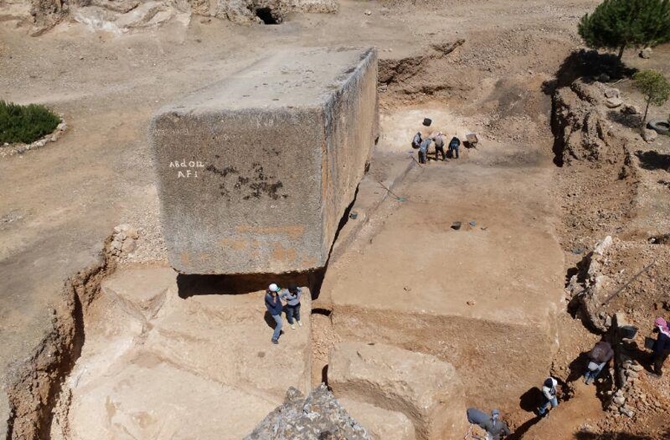
Next to the fully exposed Hajjar al-Hibla stone and partially underneath it, the archaeologists found a third block still partially buried.
Shown above at right, the monolith measures 19.6 meters (64 feet) in length, 6 meters (19.6 feet) wide, and is at least 5.5 meters (18 feet) high. Its weight is estimated at 1,650 tons (that’s about 33,000,000 lbs) making it biggest stone block from antiquity.
“The level of smoothness indicate the block was meant to be transported and used without being cut,” the German Archaeological Institute said in a statement. “Thus this is the biggest block known from antiquity,”
The team worked under the local supervision of Jeanine Abdul Massih:

Archaeologists believe the limestone blocks date back to at least 27 B.C., when Baalbek was a Roman colony and construction on three major and several minor temples began, lasting until the 2nd century A.D.
“Massive stone blocks of 19.6 meters (64 feet) long were used for the podium of the huge Temple of Jupiter in the sanctuary,” the archaeologists said.
Only portions of the temple remain, including six massive columns and 27 gigantic limestone blocks at its base. Three of them, weighting about 1,000 tons each, are known as the Trilithon:

How these monoliths were transported and precisely positioned during the temple construction remains a mystery.
The newly uncovered stone block was likely cut to be used in the temple, but was probably abandoned because it was unsuitable for transporting.
Indeed, the Hajjar al-Hibla block nearby provided some clues: it was probably left in the quarry because the stone quality at one edge proved to be poor. “It would have probably cracked during transportation,” the archaeologists said.
Further excavations will attempt to establish whether the bigger block suffered from the same problem.
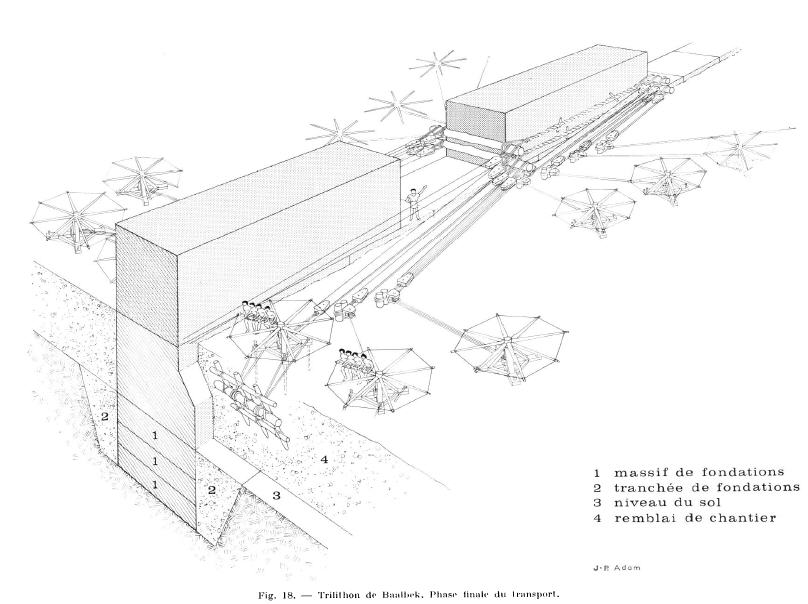
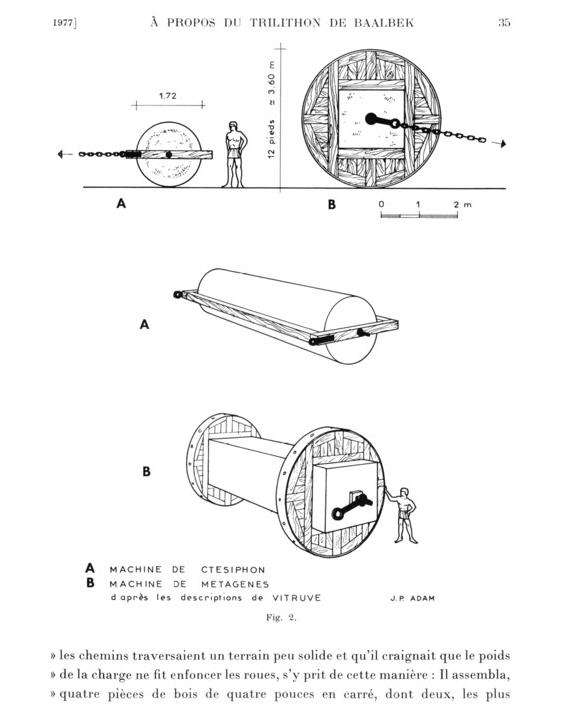
The above linked article by Dr Michael Heiser: ‘Transporting the Trilithon Stones of Baalbek: It’s About Applied Physics, Not Ancient Aliens’ is fascinating. Here are a couple of its diagrams from ancient and older sources:


 Stannous Flouride's Book of Truthiness